How AI Is Improving Retail Inventory and Supply Chain Management
This is that feeling when you aren’t selling anything and a customer is standing there begging you for something that is on the shelf and you’re sure had it last week. For years, only spreadsheets, guesswork and hoping were used to maintain inventory. That’s changing rapidly, and believe me, it’s amongst more of the practical uses of AI I’ve encountered—and like I said, not eWFEs, but quietly transforming the way goods get from warehouses to store shelves.
Earning profits using the Old Method
Historical sales data, and traditional seasonal patterns, were used for forecasting inventory. The store manager would see what had been selling last November, and order about the same for this November. Retail isn’t about repeatable cycles a prosperous, healthy business is simple. Whether it’s a viral TikTok trend, a sudden cold snap or a competitor offering a better price, none of these factors can predict when demand is going to go flying. A supply chain made up of fixed deadlines fails under such pressure—or it is about wasted inventory stored in a back-room, or empty shelves resulting in lost sales.
Introducing AI and where it fits in the equation
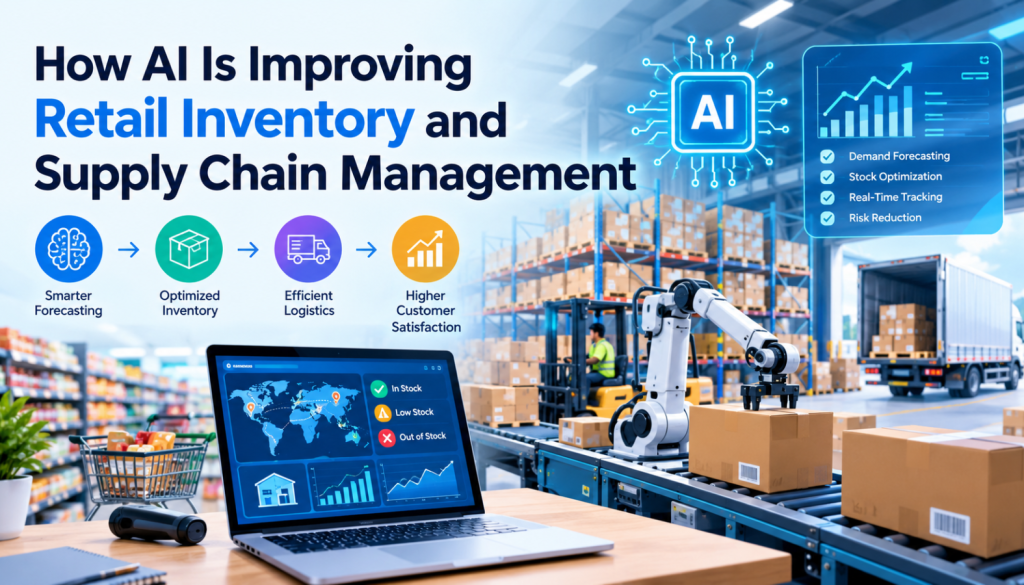
Unlike legacy forecasting models, AI-based demand forecasting incorporates a much broader range of signals. Machine learning models can put all of it in the mix: Weather, local events, social media sentiment, even competitor pricing — adjusted to reflect each and every day of the year, and made possible by being fed all of this data in near real time. This means a retailer doesn’t simply need to calculate things that happened in the past month – they can predict things that are going to happen in the next week, based on what’s currently happening.
This is because this is where you can see a huge difference at SKU level. A large chain store may have hundreds or thousands of specific items in stores. No man team can practically configure it for every one. AI can perform much the same function as applying one national forecast nationwide but with micro-adjustments applied on a store-by-store basis, rather than an entire nation wide adjustment.
But that’s not where it ends for warehouses – get smarter too
It isn’t only about what to predict to purchase—it’s everything about moving that product efficiently once it is ordered. AI routing software combined with warehouse robotics determines which is the quickest route for picking items, which saved lots of walking time that used to consume a significant portion of a warehouse worker’s time. Computer vision systems are being used on shelves and pallets to detect discrepancies in these products before it is too late to avoid a “fulfillment error” three states away.
There is the supply chain visibility component, too. Now AI tools can monitor deliveries from several carriers and alert you to disruption before it creates missed deliveries, be it a port delay, a weather event, a customs hold-up or something else. Retailers instead of receiving complaints about a delay, receive an alert days before a shipment delays and reroute or adjust them to alternate destinations.
A helpful analogy: The rare vs the routine
Consider the approach of arranging a large amount of trading cards in a collector. You’re rolling a standard, easy-to-spin poker chip and then you’re landing a rare and high-dollar card that takes everybody’s interest the instant it’s pulled from your bag. The dragon pokemon card from the set is more likely to be in demand than the common-type card from the same set, even if it doesn’t offer much in the way of power.Just by being hot and rare, a dragon card is more likely to be in demand than a common-type card from the same set without any special power. Then there’s retail inventory which operates on the same principle. AI systems essentially perform that separation at scale, on an almost continuous basis, moving the “moves fast” items from the shelves to restocking and moving the “rare” high-margin items less often from restocking to the shelves and dynamically adjusting shelf space and Reorder Points as needed.
Interestingly, the approaches in organizing collections are not that far off in spirit from what retailers do for inventory triage. A Favorite Pokemon Picker is essentially a way for some particular person to narrow down all the different Pokemons within their collection and bring the ones that matter the most to the forefront of their mind – a concept that applies to a much larger commercial inventory, when the inventory of items is vast and chaotic.
The Human Side Doesn’t Disappear
None of this means that store staff and the store’s supply chain are being demoted. The job is changing, not the nature of the job. Rather than relying on manual inventory checks and making educated guesses about reorder processing, they’re checking solutions the AI can make and adding in their own expert knowledge (such as knowing in advance that there’s a local event approaching that causes an increase in demand for something the AI system hasn’t seen). The ideal applications focus on AI as an aid to decision-making rather than a replacement.
Smaller Retailers Are Catching Up
Having been a tech developer for quite some time this sort of tech was only available to huge retailers with extensive technology budgets. That’s shifting. In a way, the playing field is even, as subscription-based AI inventory systems now exist and are accessible for smaller chains and even independent stores to access, which was unthinkable 5 years ago.
Where This Is Headed
The future of the integration between forecasting, warehouse automation, and last mile delivery is likely to be even deeper—there’s a chance that all of this data will feed back into a single system, in real time. Early retailers are not so much cutting costs; they are developing the level of responsiveness which will prevent customers from ‘going shopping without because they didn’t get here early enough.’
AI won’t replace the core principles of effective stock management. It’s the chrome button that is finally putting the power of unpredictable modern shopping behavior in retailers hands.